 English
 Español
 Tiếng Việt
 Deutsch
 Français
 Português
 Polski
 Nederlands
 Italiano
 Svenska
 Norsk
 Dansk
 Suomi
 Čeština
 हिन्दी
 العربية

To add up a week of crew hours, work out each shift in hours and minutes, take off the unpaid break, add the shifts for each day, then add the days. Convert to decimal hours once, at the very end. The two classic mistakes are mixing minutes with decimals and forgetting that a night shift ended on a different day than it started.
1. Each shift, in hours and minutes
Take the clock-in and the clock-out and subtract. Stay in hours and minutes. A shift from 7:04 AM to 3:36 PM is 8 hours 32 minutes.
Then take off the unpaid break, per shift and not per week, so you can see which shifts actually had one. A 30-minute unpaid lunch makes that shift 8 hours 2 minutes.
Doing this on Friday afternoon from a pile of slips is where it goes wrong. In TimeGO the worker starts and ends the break in the app, and the Hours tab shows each shift with its break minutes. By hand, it is still worth doing in this order.
2. Shifts that cross midnight
A shift from 10:47 PM to 6:36 AM has an end time earlier than its start. That means it finished the next day. Add 24 hours to the end and subtract the start: 30:36 minus 22:47 is 7 hours 49 minutes. Take off a 30-minute break and you have 7 hours 19 minutes.
Then decide which day the shift belongs to and write the rule down. A common choice is the day it started. The rule matters less than using the same one every week, because Sunday night into Monday is where week totals drift from one payroll to the next. Your accountant can tell you which day it should count toward where you operate.
The free shift hours calculator does this subtraction: start, end and unpaid break in, paid hours out, and an end earlier than the start counts as the next day.
3. Add the day, then the week
Two shifts in one day? Add them for a day total first. Then add the day totals. A made-up week:
| Day | Paid time |
|---|---|
| Monday | 7 h 42 min |
| Tuesday | 8 h 06 min |
| Wednesday | 7 h 51 min |
| Thursday | 8 h 13 min |
| Friday | 7 h 38 min |
| Week | 39 h 30 min |
Add the minutes on their own: 42 + 6 + 51 + 13 + 38 is 150 minutes, which is 2 hours 30 minutes. Add the hours: 7 + 8 + 7 + 8 + 7 is 37. Together, 39 hours 30 minutes, or 39.5 hours.
Only now convert, and convert minutes by dividing by 60. Seven hours 42 minutes is 7.7 hours. Typing it as 7.42 loses 17 minutes, and doing that on every line of a crew’s week adds up to real money one way or the other. The weekly time card calculator adds a whole week if you want to check your own sums.
4. Rounding, if you use it
Some companies round to 6 minutes, a tenth of an hour, which keeps decimals clean. Some round to 15. Take the 7 hours 19 minutes from the overnight shift:
- rounded to 6 minutes: 7 hours 18 minutes, or 7.3 hours;
- rounded to 15 minutes: 7 hours 15 minutes, or 7.25 hours;
- not rounded: 7 hours 19 minutes.
Pick one rule for the whole crew and apply it the same way every week. One caution: the calculator rounds a shift’s paid total. A time clock that rounds the clock-in and the clock-out separately can land on a different number. TimeGO rounds the first clock-in and the last clock-out of the shift. We compared the options in should you round to 6 or 15 minutes.
5. Read the week before it goes anywhere
- Missing punches: a clock-in with no clock-out, or a shift far longer or shorter than the rest.
- Overnight shifts: each one on the day your rule says.
- Breaks: every shift that should have an unpaid break shows one.
- Corrections: every change someone asked for has been made.
- One worker by hand: add one person’s week yourself and compare it with the timesheet. If it matches, the method is right. If it does not, find out why before you export anything.
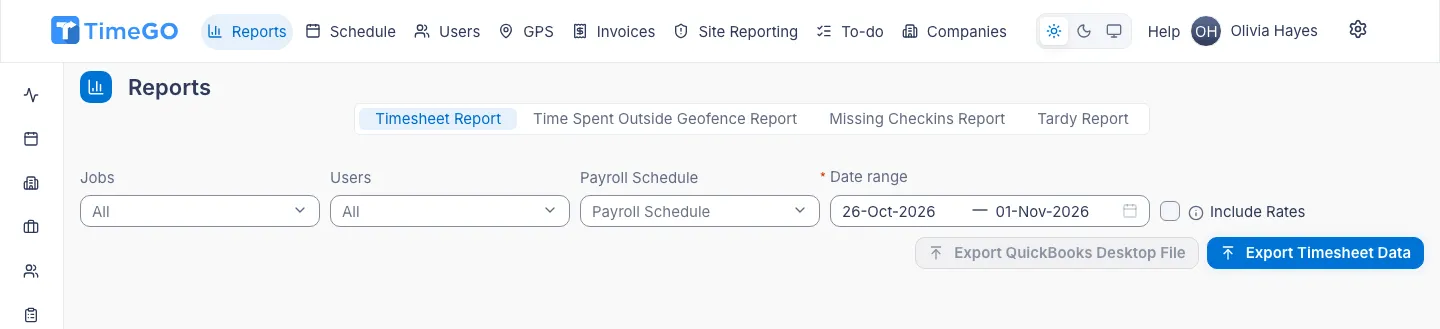
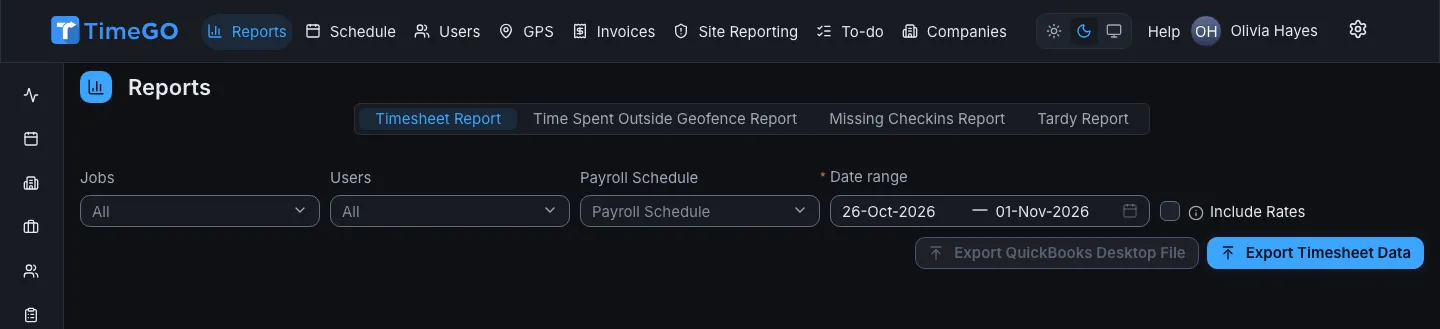 Once the week checks out, it leaves as an Excel file or a QuickBooks Desktop file from the Timesheet Report.
In TimeGO, those clock-ins come from the phone at the job site, with GPS, and each finished shift lands in the timesheet with its break and its job. The checking in step 5 does not happen on its own, and should not: a person reads the week before it is paid.
What this post does not cover
Which hours count as overtime, whether a break is paid, and which day your work week starts on are rules, and they differ by state and sometimes by job. This post is the arithmetic only. Check the rules with your accountant or payroll provider.